Saturday, February 20, 2016

Master Timothy Galvin - Part III

April 21, 1821

Mr. Randall Johnson, Clerk of the First Congregational Parish of Westbrook;
Let me not be considered a member of this parish.  I am in belief a Universalist.
Sir Yours,
Timothy Galvin

This statement was published in LB Chapman's Grampa's Scrapebook and led me to consider the significance of Timothy's letter, and to wonder what was happening at the time he chose to write.   Mr Chapman devoted several articles under the heading 'Westbrook, the Battlefield of the Religious Clans.'  The following contains the names of others who also petitioned to be dismissed from the Congregational Parish.  Some of the names will be familiar to people who follow this blog and are interested in the history of Portland, particularly that of the Back Cove (East Deering).


You will note the names of  Timothy Galvin, Joseph M. Sawyer and Brackett Sawyer, all souls interred at the Grand Trunk Cemetery in East Deering.
     1820  Maine becomes an independent State.  The state Constitution is ratified,and modeled after the United States Constitution, contains in Article I,a section on religious freedom which reads:
 All men have a natural and unalienable right to worship Almighty God according to the dictates of their own conscience, and no one shall be hurt, molested, or  restrained in his person, liberty, or estate, for worshiping God in the manner and season most agreeable to the dictates of his own conscience, nor for his  professions or sentiments, provided he does not disturb the public peace, nor obstruct others in their religious worship; --- and all persons demeaning  themselves peaceably, as good members of the State, shall be equally under the     protection of the laws, and no subordination nor preference of any sect or denomination to another shall ever be established by law, nor shall any  religious test be required as a qualification for any office or trust , under this  State;  and all religious societies in this State, whether  incorporate or un-incorporate, shall at all times have the exclusive right of electing their public teachers, and contracting with them for their support and maintenance.
To get a grasp on the importance of Timothy's actions and that of the others, I needed to go back in time to the formation of the Ancient town of Falmouth when Maine was a district of the Massachusetts Bay Colony; a colony within a colony. At this time,  Falmouth comprised all of what we know as Spurwink (Cape Elizabeth and South Portland), the Neck (Portland),  Presumpscot River (New Casco/Falmouth), Capisic (Stroudwater) Sacarrapa (Westbrook) and Back Cove (Deering), and some of the Islands. 

     In 1718,  when Falmouth was established,  there was no separation of Church and State. On the contrary, only 'freemen' were allowed to vote and property owners were compelled under the union of Church and State to pay rates for the support of one legalized church.; explicitly the Standing Order; the Orthodox Congregational Church.

      To become a freeman each person was legally required to be a responsible member of the Congregational Church.  The person was made a freeman by the General Court of the colony, and also by the quarterly courts of the counties.  None but freemen could hold office or vote for rulers.  The regulation was far modified by Royal edict in 1664, as to allow individuals to be made freemen who could obtain certificates of their being correct in doctrine and conduct from clergymen acquainted with them.  This ruling applied at the initial settlement of the area, but still had implications for those who came after hostilities had lessened from the French and Indian Wars.

    On or about the early 1720's Isaac Sawyer and his brothers came to the area.  Isaac, his wife and children had come to Maine from Gloucester, Massachusetts.  William Willis' History of Portland and the Rev, Thomas Smith in his Diary  refer to Sawyer as a proprietor of the First Church of Falmouth as having signed a covenant as one of the first members on July 19, 1727.  Isaac sawyer was the grandfather of Anthony, Zachariah and Thomas Sawyer that I have written about in earlier posts of this blog.

     The first settled minister was Rev. Thomas Smith, 1727 - 1795.  He could rightly be called the 'Traveler' because he ministered to his scattered flock over a very large territory, until age and infirmity brought the Rev. Samuel Deane to be his associate pastor in 1764.  Dr. Deane remained an associate Pastor until Rev. Smith's death and then continued to serve as Pastor until 1814

Rev. Thomas Smith

The Rev. Samuel Deane


      Meanwhile the area closest to the Bay and the rivers grew in population because of the advantages of commerce and trade.  After 1783, and the Treaty of Paris, the Port on the Neck became the sixth largest in the nation and "Maine's cultural and financial center."
Deering: A Social and Architectural History by William David Barry and Patricia McGraw Anderson.  

     The back country which grew as well, but at a slower pace, developed its own unique character and the differences created divisions within the communities.  Up to this time, all the business for the district was conducted at the meeting house of the First Parish on the Neck creating hardship for those residing in the scattered villages and corners.  The one parish needed division to meet the needs of those who had to travel and whose interests were changing.

     On July 4, 1786, the Neck separated from Falmouth and was incorporated as Maine's 46th town and became the town of Portland.  The town was comprised of the 'Neck, Casco Bay Islands, and a 'slice of land from Back Cove to Round Cove."  The area of what is now Stroudwater, Westbrook and Deering remained a part of old Falmouth.

     Cape Elizabeth withdrew from the original Falmouth in 1765.  Prior to this, however, the citizens of Stroudwater, about thirty in number, complained about the great distance to the First Parish and petitioned for separation so that they could form their own parish.  Some petitioners actually wanted to leave the Congregational society and join the Anglican church which they did in 1765.  The remainder ultimately formed what would become the fourth parish whose boundaries  encompassed Sacarrapa, Stroudwater, Back Cove to Martin's Point,  to the entrance to Deering Oaks from Forest Avenue, to  Riverton, Woodfords and Morrill's Corners and Brighton's Corner.  The area we know as North Deering was already established by the Quakers.

     It's important to remember that Deering did not become a separate entity until 1871 when it separated from Westbrook. The town of Deering was not annexed to Portland until 1898. 

    Which brings me to reflect on our East Deering/ Grand Trunk Cemetery a bit.  Those of you who have had occasion to visit and stop at the kiosk containing the graphic depiction of the cemetery layout,  will notice that there are four names given to the sacred ground: first, Presumpscot.  That is what you will find on the very old cemetery records, and probably reflects the cemetery's proximity  to the River by the same name.  Second, Back Cove. That is the name of the first settlement. Third, East Deering,  so called once the town of Deering was formed, and last,The Grand Trunk, after the advent of the railroad whose tracks still exist just below the cemetery. 

     In 1764, the Rev. Thomas Browne was invited to preach in Falmouth, but apparently he was not well received by the Pastors of the First Parish. He had a somewhat controversial  
nature and a reputation as a rebel.  However, he was officially installed as the Pastor of the new Fourth Standing Order Parish in 1765 and served the parish for thirty two years until his death at the age of 62.  The Church and Meeting House was built on Capisic Street, on the corner of Brighton and Stevens Avenue.

Tombstone of Rev. Thomas Browne Stroudwater Burial Ground
  
The original 4th Parish building from 1764 was a simple one story church, 40' x 30', with no pews, only simple benches.  In 1884, the church was expanded to meet the needs of a growing congregation.  This building was now two stories, with two rows of windows, and a high vestibule. (Description borrowed from Scott Leonard's blog:  Old Blue Genes) 


     In 1799, the Rev. Caleb Bradley succeeded as the pastor of the Stroudwater Parish, and held that post until his retirement in 1829.  According to the Westbrook Historical Society, he married some 500 couples and officiated at 1400 funerals.  The following documents include the names of members of this parish.

The Rev. Caleb Bradley 1771 - 1861


      In 1807, the Embargo Act devastated the lumber industry and timber production of the Stroudwater area was all but dead leaving many people in poverty.  The same was true for the Port and the people of Portland.  Massachusetts abandoned Maine to its own devises during the War of 1812 thus propelling the charge for statehood.

     On February 14, 1814, Stroudwater separated from the old Falmouth and became the city of Stroudwater for three months, when it was renamed Westbrook to honor Col. Thomas Westbrook.  The town boundaries included today's Westbrook and Deering and were set off by the towns of Gorham, Windham, Falmouth, South Portland and Scarborough.

     Although the war created turmoil for many, Westbrook flourished with the building of new mills and factories and trades.  This include the area of Stevens Plains and parts of Back Cove.  The war had little effect here and instead created some prosperity. 

   The first town meeting was called by then Justice of the Peace, Archelaus Lewis before the name was changed to Westbrook and held at the Bradley Meeting House.


         Early in the 19th century, actually, 1821, about forty members of Parson Bradley's parish, 'Stroudwater Congregational Church, then called the First Church of Westbrook, petitioned to be dismissed because of 'their Universalist tendencies', and not wishing to be further taxed to support the original parish or its minister.  They wished to form a free meeting house on Saco Street.  According to the Westbrook Historical Society, a church building was constructed on Upper Main Street in 1832, but did not seem to serve the needs of the members.  However,at the same time as the separation which took place in Westbrook, in 1821, the First Universalist Society of Portland was instituted. The first church was a wooden building constructed on the corner of Congress and Pearl Streets. The Rev. Russell Streeter became the first minister.

     In 1829, the First Universalist Society of Westbrook was founded.  In 1867, they built the New Universalist Church on Stevens Avenue at the Westbrook Seminary (which became Westbrook Junior College) and now, the former church is the University of New England's Ludcke Auditorium.

     From the beginning of Portland's foundation, with all the changes in names, territories and boundaries, its citizens,  whose lives are woven into the tapestry of history,  have exemplified courage and fortitude to make their way in those challenging early years of war and peace, poverty and prosperity.   I think this was true of Timothy Galvin, teacher, husband and father and free man who made decisions and choices which shaped his future and presented us a true portrait of the lives of our early forbears in the city of Portland and our state of Maine.  I have tried to be as accurate with the dates and events while knowing that this is just a partial picture, and there is much more that could be added to the historical record.  My hope is that others with more threads will continue to weave into this tapestry.

Wednesday, February 3, 2016

Master Timothy Galvin's Children - Part II


Thank you, Leonard Bond Chapman

for setting me off on a genealogical detective adventure.  Your article about Master Galvin made me curious, and sent me off on a journey to search for more clues about Timothy and his children.  I am pleased to share what I've uncovered, and hope that other searchers may find this useful and will share whatever bits of  information to add to the story of his life.

From "Grampa's Scrapebook"


     George Ilsley Galvin was probably the eldest child born to Timothy and Joanna Ilsley Galvin, born about 1797,  and died in Calais, Maine on July 29, 1841.  I found a military record for George indicating he served in the Militia during the War of 1812 in the Hobb's Regiment.


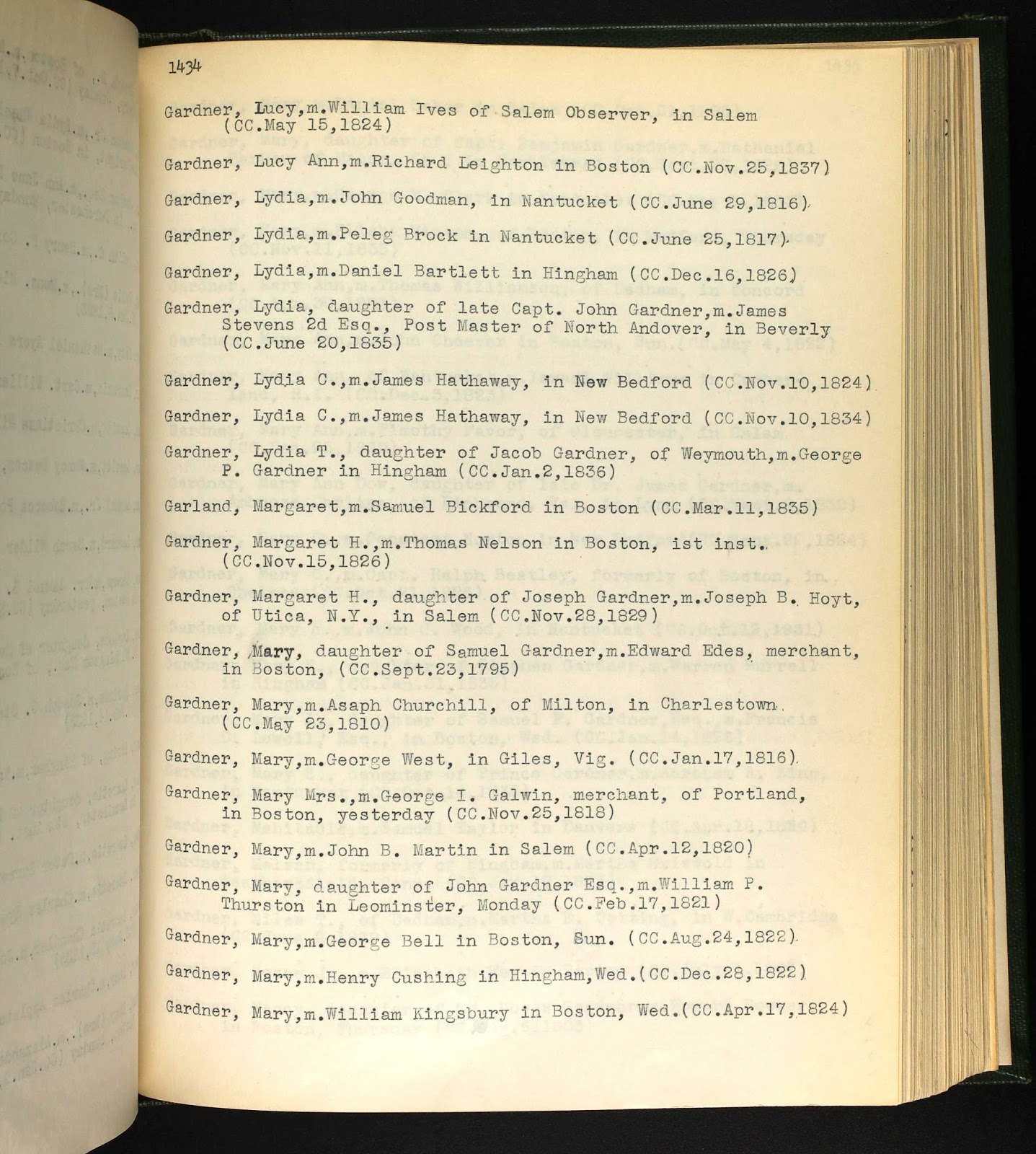
     Sometime after the War of 1812, he moved to Boston where he married Mrs. Mary Gardner on November 25, 1818.


     Unfortunately, there is no other information about their marriage. Did Mary follow George  back to Maine and, sometime around 1830, locate in  Calais?  I've learned that George lived in Calais until his death in 1841, where he was employed as a lumber merchant. 

     We do know that in 1822, Timothy Galvin sold "his house and shop standing on (the)  land of Jane and Peter Lunt to his son, George Ilsley Galvin of Boston, Mass."  Grampa's Scrapebook Later, in 1837, George sold that property to his brother Thomas P. Galvin of Calais, Maine.

     I want to acknowledge three great resources that have been vital to what I've been able to discover about the Galvin children.  First:   Vital Statistics of Calais before 1892, vol. 2, by Susan Howland, second:  "Annals of Calais, Maine and St. Stephen, New Brunswick, including the village of Milltown, Me., and the present town of Milltown,  N.B.", and third:  http://www.uuholton.org/newslett/nl-04-11.htm.

     In the winter of 1832 -33, a request was sent to the State Legislature requesting the building of a church,  to be established in Calais for the first Unitarian Society

     George Ilsley Galvin served as a committee member and was later voted an officer of the church.  Apparently, he was regarded as a successful and influential businessman of the time.  Apparently he owned and operated a lumber mill in Calais.


 The church records, most of which were lost in a fire during the late 1800's, reveal some valuable information about George's sister, Eliza  Galvin and her two husbands, Otis Patterson and Rev.William Augustus Whitwell, and her brother, Thomas P. Galvin and his wife, Martha Ann Goodhue (Jones) Galvin.  It is clear that Eliza and Thomas followed George and located in Calais sometime around 1830.  

     As to George's other involvements, I found an article about the Whig Party Convention in 1834 that took place in Augusta.  Three thousand people attended from all over the state to take up the issue of naming a candidate for Governor.  Peleg Sprague was chosen; " a tried public servant, and one well able to discharge the duties of that important station, and that we will use our best efforts to effect his election, and insure the political regeneration of this State."  

     George Ilsley Galvin was one of the representatives from Washington and Hancock Counties. The convention also took up the matter of President Andrew Jackson and created and approved resolutions to express their dissatisfaction and abhorrence to his administration.  The resolutions were read by William Pitt Fessenden of Portland.  Articles about the convention were published in the Portland Advertiser, vol. XXXVI , dated August 5, 1834 and Maine Working Men's Advocate on Thursday, April 7, 1834.
  
     LB Chapman described Eliza Galvin as "rather above the average of 'the outside world' in personal charms, and is said to have married a Unitarian Minister." 

     Indeed she did!  Eliza actually was married twice. Her first marriage on January 24, 1836, to Otis Patterson, a lawyer originally from Waldo, ended with his death, barely a few months after their wedding.  According to a piece in the Annals of Calais:
Otis Patterson, Esq., came from Waldo county and settled in Calais about 1832, and opened an office.  He died four years afterward; but his brief career proved him a man of fair ability and sterling integrity.  His widow, whose maiden name was Galvin, married Rev. William A. Whitwell, the first pastor of the Unitarian Church of Calais.

     Eliza Galvin was born about 1802. ( I have not found any birth records s for any of the Galvin children in existing resources.)  She died at the age of 81 years old on November 25, 1883,  in Germantown, PA,  where she lived with her brother Thomas P. Galvin and his family for many years,  after the death of her second husband, the Reverend William Augustus Whitwell.  William and Eliza were married about a year after the death of Otis Patterson, on May 21, 1837.  

    The couple met in Calais  where William was the first Pastor of the newly formed Unitarian Society.  Shortly after their marriage,  he took the pulpit in Houlton, Maine, where they lived for about three years.  Apparently, the Rev. Whitwell was loved and esteemed as is indicated in the following newsletter.  I enjoyed reading it so much that I want to share it in its entirety; well worth reading!


Restored Portrait of Rev. William A. Whitwellgiven to the Unitarian Society by Miss Charlotte Galvinfrom the estate of Eliza Galvin Whitwell


     After William's death on February 10, 1865 in Chestnut Hill, Newton, MA, Eliza moved to the Philadelphia area to live with her brother Thomas Galvin and his family.  Here are a few records for Eliza that might be beneficial to other Galvin family researchers.


Eliza was living with her brother in 1870 about five years after William's death.


     Thomas P. Galvin was born about 1811 or 12, depending on which records you look at.  He may have been the youngest of the Galvin children.  Unfortunately, I was not able to find any information about his brother, Edward Galvin, but I assume he may have died young and it's very evident that he was regarded very highly,  as Thomas Galvin's oldest son was named for him.There appears to be one grandson who also carries the name Edward IIsley Galvin.  Ilsley was of course, Joanna Galvin's maiden name.  

     Thomas Galvin probably moved to Calais with his brother and sister in or about 1830.  He was also in the lumber business, perhaps with George.  On June 19, 1837, he married the widow, Martha Ann Goodhue Jones.  Martha was a communicant of the First Unitarian Church as well, and mention of her is recorded in Annals of Calais in the history of the church.

     Martha who was born in Newburyport, MA,  married Benjamin F. Jones on October 11, 1830 in Portsmouth, NH.  The couple had three children:Frank Shannon Jones who died in infancy, Elizabeth C. Jones,  1832 - 1845 and Charles Hayden Jones, 1833 - 1920.  It appears that Charles was born in Maine where the couple had moved.  I believe Benjamin Jones died sometime in 1834.

     On June 19, 1837, the widow, Martha Ann Goodhue Jones married Thomas P. Galvin in Calais.  Their union would produce five children:  Edward Ilsley, b. April 3, 1838, Charlotte Whitnell, b. September 17, 1840, Laura Wood, 1843 - 1866, Mary Shannon, b. April 19, 1845, and George William, 1848 - 1849.  Sometime after Charlotte's birth, records show that the family located in Philadelphia, settling in Germantown, PA until their deaths.


1840 Census in Calais, MaineNote there is a female listed between the age of 60 and 69.  Could that be Joanna Galvin?

          The following are records indicating that the Galvin's were  citizens of Philadelphia, PA  There is also a reference to Thomas's employment in the lumber industry and Eliza Galvin's residency in the family's home until her death in 1883.


          Martha A. Galvin died on May 11, 1889 at the age of 81.  Her husband, Thomas P. Galvin died in April 1892 at the age of 80.  At the time, the family home was located at 41 West Walnut Lane in Germantown, PA.  Eliza Galvin Whitwell was interred on November 27, 1883 at the  in Philadelphia,PA.

     I have a few more interesting pieces to add the Galvin story,  but they will have to wait for another day.  Again, I love the path set by our friend, LB Chapman and his story of Master Timothy Galvin.  Part three to follow.

Friday, January 22, 2016

Master Timothy Galvin, A Household Name

A New Year  New Discoveries


19th Century School Master


     Of course, this is not a photograph of The Timothy Galvin.  As far as I know, to date, no photographs exist.  However, Leonard Bond Chapman, editor and publisher of the Deering News (1894 - 1904), provided some marvelous images of the man that I want to share so as to add to the story of the souls interred at the East Deering/Grand Trunk Cemetery.

     You may remember my writing about Leonard Bond Chapman in previous posts as the 'unofficial' caretaker of the ancient cemeteries in Portland until his death in 1915, but he was so much more.  LB Chapman was a prolific writer and invaluable caretaker of the history of Deering which is preserved in Grampa's Scrapebook.  In November, in my last post, I mentioned that our friend, Herb Adams loaned me his copy of the reformatted and indexed book, by Thomas Shaw Henley,  particularly for the  article about Tim Galvin. 
Since that time, 'Santa' brought me my own copy and it has provided many genealogical tidbits. I recommend this book to those of you doing your own genealogical detecting; no doubt you will find it helpful.


     William David Barry and Patricia McGraw Anderson in their book Deering:  A Social and Architectural History , p. 111, said this:
....the News' great impact (was the) minute coverage of events, political spice
             and peerless historical and genealogical columns, providing Deering 

             with a relevant and useful written legacy. 

From the book:  Deering, p.69


A very early photo of LB Chapman

     LB Chapman devoted an entire article to Timothy Galvin on page 21 of Grampa's Scrapebook.  Although I'm unsure of the date it was published, he references:
 Ninety years ago and later,  the name of Timothy Galvin was a household word hereabouts.  He was an Irishman, born in Ireland, February 2, 1766 married, March 12, 1793, Joanna Ilsley.  The Ilsley's lived where Hawkin's shoe factory is located on Ocean Street.
      In my earlier post about Timothy Galvin, I listed the year of his birth as 1776 taken from the Maine Historical and Genealogical Recorder, vol. IV which contained the inscription from his tombstone. I also listed his marriage to Joanna Ilsley as having taken place in the year 1795, the year he arrived in Maine from Ireland, not as Chapman indicated as 1793.  If the year of Timothy Galvin's birth is accurate, then he was three years older than Joanna and not,  as I had written, nineteen at the time of their marriage and she, six years older.   He would have been twenty-nine which seems more in keeping with the 1810 census I included in the earlier post.  Much more interesting and intriguing to me and, I hope to you,  is Chapman's description of the man known as Master Galvin.  He write:
He was short in stature, quick in motion, an excitable temper, full of wit, slight brogue, stood high as a mathematician, a surveyor of land, shopkeeper and schoolmaster.  His name, however, is seldom found in historical research.
In 1810, the two story schoolhouse was commenced that was located on the site of the present one at Stroudwater, and Master Galvin was notified that when finished, another teacher would be employed as he did not understand grammar sufficiently well to teach it, whereupon he obtained a grammar and went to work on it.  When the schoolhouse was ready, he was also ready to teach grammar as well as other branches of study.
     

The Bradley Meeting House and School House

     Timothy Galvin received $115. 37 for 'keeping winter school in Stroudwater" in 1815 from Mr. Charles Pierce, on behalf of the School Committee at that time.  In 1816, he received a payment of $33.00 per month for teaching in the first district of the Stroudwater parish.  LB Chapman also alludes to Timothy's propensity for humor with his students and his sayings and little speeches which have faded over the years.
If the boys were in swimming or sliding, or engaged in any other amusement and discovered by Master Galvin, he joined them, and fifty years ago, his little speeches were repeated, and acts described, but now allusion to him is seldom heard.
      Mr. Chapman relates two stories that are worth telling.  One was told to him by a woman, a Mrs. Eleanor (Tate) Jordan who lived at the time of their meeting in Gorham, but as a girl was a student of Timothy Galvin. Mrs. Jordan was born and lived in Stroudwater Village and described the School Master's 'pranks.'  

     It seems the class was having what we know as a spelling bee, but before beginning, Master Galvin took her aside and told her how he wanted her to spell the word 'grape'. When the time came, Master Galvin asked the class to spell the word 'grape' in Irish. When they all failed. he called up Eleanor to spell the word, and she did:  "po-ta-to; potato!"  "That's right," said he "take the head of the class."

I learn that he (Master Galvin) once informed his scholars that when a person stands back to a stove, with hands back of himself, palms out, with fingers turned up like fish hooks, it is no harm to place a coal of fire in them.  So he was observed in the position and one of the large boys crept up behind him stealthily, dropped a live coal in one of his hands and returned to his seat.  He said, "The teaching justifies the example. 

I am so delighted that these stories survived for the telling.  Over the last few years of writing this blog with the purpose of preserving what little remains of the life stories of the residents of that early East Deering Village, finding "Grandpa's Scrapbook"  in this re-formatted version is a gift.  

     In my earlier writing I was only able to find two names of the Galvin children:  Harriot 1800 - 1805, and a son, George Ilsley Galvin c. 1797 - 1841. Leonard Bond Chapman includes the names and a bit more about three others.  They are Eliza, Edward and Thomas P. Galvin.  I will write more about what I've learned about these off-spring in another post as well as information about Timothy's property and his activities in the town.

I'd like to end this bit by sharing a personal story of an event  that took place right before Christmas.

     Our daughter Rachel was visiting for the holidays with her husband and their three children.  I had prepared two wreathes to take to the GTC, but decided to wait until the family arrived so that the girls, Alaina, seven and Joelle, 4  might help with the placement. So on the 22nd, we set off for the cemetery for the task at hand.

     Upon entering the gate, I pointed out the newly planted garden behind Zoe's bench. Zoe Sarnacki had been a little girl and student at Presumpscot School years ago, before her untimely death at eighteen.  As a child, she and her classmates engaged in a special project to restore the cemetery and, wanting to remember her, Samantha Allshouse and Kayla Theriault along with the other members of their Girl Scout Troop obtained a memorial bench to honor her as their final gift as graduating  Girl Scout members.

     As I was relating this story, I noticed that Alaina immediately left us and walked directly to the grave of Harriot Galvin.  Apparently, she remembered my pointing out the site with the broken  stone from an earlier visit to the cemetery.  She must have remembered what I had related about Harriot, that was just a little girl of five years old when she died, and that she was buried next to her Daddy.  

     I  noted Alaina's demeanor. She was solemn and very quiet; a rare moment for a lively and curious seven year old.  When she turned away after two or so minutes, still very serious, she asked: "Nana, why did that little girl die?"

    Touched by her concern, I said:" I don't know, Honey.  I suppose she had a very bad sickness and the doctor couldn't help her to get well."  As if on cue, from behind us, the four year old, Joelle piped up with: "The little girl is in Heaven, Alaina.  She's OK!
The inscription of Harriot Galvin's stone reads:
                                      "Of such is the kingdom of Heaven.".


Wednesday, November 11, 2015

WHERE DO WE GO FROM HERE?

    It's been well over a month since the Dedication ceremony honoring Revolutionary War veteran Joseph Lunt and I have been asked the question at least a half dozen times by various interested persons; "what's next' for the remnant that is the Grand Trunk Cemetery?"

     I ask myself that question each time I visit the site.  While a great deal has been done over the last five years to preserve the integrity of the small ancient burial place of the early settlers of East Deering village,  and some progress has been made to restore a small part of the historical record, the fact remains that there are approximately 150 souls interred here whose names we may never know.  The WPA grave forms which could give us valuable information about the identity, dates of birth and death are missing, lost somewhere in the vaults of City Hall or elsewhere.  In the scheme of today's events and concerns, some might ask if expending this much energy to preserve such a small piece of historical real estate is insignificant.   Is it important to the Portland community?

     Fortunately, there are a number of us, crazy people,  who view cemeteries as a treasure trove for discovery, i.e.;  the stories of people, events and places.  Some cemeteries are replete with art and culture.  All are sacred , in my opinion,  final resting places for men, women and children who lived and died and made their mark in the place in which they lived, no matter how small or great.  

     Historians, genealogists, story tellers and local groups like the Maine Old Cemetery Association, Spirits Alive and Friends of Evergreen Cemetery remind us of the importance of preserving and maintaining our ancient cemeteries. I am grateful for all of their efforts.

     Now, getting back to the original question:  "where do we go from here" or the better question: "what plans are for the future of the Grand Trunk Cemetery?"

     *I will continue to add to the historical record as I find additional bits of information about the souls whose names we do have.  Friend and historian, Herb Adams,  recently loaned me a copy of Grandpa's Scrapbook, written by Leonard Bond Chapman and re-formatted and indexed by Thomas Shaw Henley.  I'm amazed at some of the information I've found including a wonderful article about Timothy Galvin, teacher, mathematician and so much more.  I'll share this in future posts.  

     I have also found a few more bits of information about the Blakes; Samuel and William to share later.  Unfortunately,  the relationship between  Samuel and William still remains a mystery.  However,  I did find William on the same militia role and in the same unit as Samuel.  The hard part is finding enough information about William whose date of birth and death  is in question since they were taken from an old tombstone and may not have been recorded accurately.  I may have identified William's two wives maiden names, but still needs further research.

*    I've begun conversations with Sam Heck, Director of Development at Victoria Mansion and Jessica Reid , President of the Friends of Evergreen Cemetery to consider looking into potential grants to contribute to the betterment of the Grand Trunk Cemetery.  Since City money and resources are limited, grant money might allow us to accomplish the following:
     * Have designed two street signs indicating the locale of Ancient Cemetery.  
     * Replace the old fencing and repair the walkways.  The front portion was replaced in 2014.  
     * Map the graves.  The city engineers are to re-measure the boundaries  within 2016, so that the WPA charts  and the remaining  stumps of markers can be used to identify the location of the 197 graves.  If possible, secure someone to use ground penetrating radar to help with this process. 
     * Informational sign containing historical information about the East Deering Village and the cemetery.
     *Partner with community organizations to maintain the walking paths through the cemetery.
     *Restore the cemetery archway/gate  with a sign.

    We appreciate the encouragement of the Portland community and our informal 'Friends of the Grand Trunk Cemetery' who have supported this reclamation project over the last five years since its inception as a Girl Scout Gold Award  project.  Portland Girl Scouts continue the legacy of Samantha Allshouse and Kayla Theriault by participating in the annual Fall and Spring Planting Parties and maintaining the gardens.

  Our Fall party was a success and we planted over five hundred daffodil bulbs with the additional help and donations from  Skillins Greenhouses, Sawyer family members and two lovely Daughters of the American Revolution, Elizabeth Wadsworth Chapter, and other volunteers.  Here are some photos of that event.


     This past Monday, I was joined by Portland Girl Scout Troop 1094 to prepare the gardens for winter.  The girls and their leaders cut back the spent flowers and raked oak leaves to cover the beds.  They also spent a great deal of effort cutting away the vines and brush from the fence.  It's wonderful to have these young people take such an active role in maintaining the  beauty of this little cemetery.  Hopefully, they will be the caretakers of the future.


     Finally, (for now), I want to end by remembering the Veterans interred at the Grand Trunk Cemetery.  Although Veterans Day originated as Armistice Day at the end of the so-called Great War, it is now officially the day for honoring all Veterans from the foundation of our Nation to the present. 
     Although it was cold and damp in downtown Portland this morning, the parade and ceremony to follow,  was well attended.  The weather did not dampen the enthusiasm of the participants.  The men and women of our Armed Forces today face many challenges,  difficult to endure, not unlike our fore fathers and mothers.  We remember and thank them for their service.  Senator Angus King spoke and his words were significant for me.  He referenced our National Anthem in its final stanza:
          O say does that star spangled Banner yet wave,
          O're the land of the Free, and
          The home of the brave?

     It is a question, and the answer lies within, he said.  We are the land of the 'free' because many were 'brave'.


Francis Smith, War of 1812 and Simon Davis, Revolutionary War


Crispus Graves, John Sawyer, Jr., Joseph Lunt, Revolutionary War
Samuel Blake, John Sawyer, Jr., William Sawyer, Joseph Sawyer, Joseph Merrill, Andrew Graves, War of 1812
James Moseley, Civil War