Friday, July 8, 2016

FILLING THE HISTORICAL THIMBLE


PRELUDE

In 2004, on a visit to Washington, DC with my best friend who had never had the occasion to visit our Nation's capitol, we witnessed the amazing work underway to conserve the flag that inspired Francis Scott Key's poem which  became our national anthem.  The flag which flew over Baltimore's Fort McHenry was raised on September 14, 1814 to celebrate an important victory over the British during the War of 1812.  It took a decade of painstaking and meticulous work when the flag was moved to a specially constructed conservation lab museum.  Visitors like us, in 2004, observed the process through a fifty foot long glass wall.  A movable bridge (gantry) created a working surface for the conservation team, above the flag.  The lab was equipped with its own heating, air conditioning and ventilation systems to ensure steady temperature and humidity and to keep the air free of any damaging contaminants.  It was an amazing endeavor to witness!


In 2011, I returned to Washington, this time with our wonderful, long-time, Girl Scout Troop on their 'graduation' trip planned for over two years.

     By this time, the 'Star Spangled Banner' was moved to its permanent location and could be viewed in all its renewed glory.  Little did I know at this time,  that two of the young women, Samantha Allshouse and Kayla Theriault,  would become the force driving to restore honor to the men from the small village of East Deering (now Portland)who served in the War of 1812 and the Revolution.  Sam and Kayla's  wonderful project continues to be the  inspiration for my own continued effort to learn more about the history of Portland and to attempt to unearth the stories of these early pioneers and patriots.

     I realized that my knowledge of the War of 1812, let alone my understanding,  could barely fill a thimble.  Frankly, I remember very little from my history classes in high school, other than the reference to the date, that the national anthem came from Key's, and maybe a reference to Andrew Jackson or the burning of the White House.  I could go off on a tangent and tell you about how I, if given the opportunity, would design a more experiential approach to teaching American history, but that is for another day and venue.

I have heard the War of 1812 described as 'fool-hardy, forgotten, unnecessary, misunderstood, accomplished little, too costly in money, property and lives, contentious, created regional and political divisiveness, replete with mixed loyalties, encouraged smuggling, Mr. Madison's War, the 2nd War for Independence, and the war that almost lost the Union'. Hubris of a very young Nation?

 While there were genuine issues for the government, and particularly the coastal ports and towns from the Carolina's to Maine.  When the Treaty of Ghent ended the conflict on December 24, 1814, but was not finally ratified until 1815, the final document never formally addressed the two major issues that propelled American into the war with the British monarchy:  the impressment of American seamen and the interference with trade. Although for the most part, the situation returned to its 'status quo ante bellum' state.  Once war with France ended, Britain no longer needed to impress Americans to fill their muster for their Royal Navy,  and they wanted to preserve their ability to trade for American goods.  In the other theaters of the War, no territory was gained, American troops removed the threat of the 1st Nations alliance with Britain, Canada was spared and remained a British colony, and  America retained its ownership of the Great Lakes.  I realize that this may seem an over simplification in a conflict which was anything but. The War of 1812 was complicated and messy, as I believe all wars are.

No doubt poor leadership in Washington and in the field drove up the cost of this war.  The battle casualties were comparatively light:  2,260 killed and 4,505 wounded.  The number of non-battle deaths---mostly from disease---about 17,000.  The army executed an additional 295 men, mainly for repeated desertion, and the navy executed a few men as well.  Some men who had served on privateers, also died in the war, primarily from disease in British prisons.  There were a few civilian casualties as well---mostly of Indian raids in the West.  In all, the number of American deaths attributable to the war was probably about 20,000.
The War of 1812:  A Short History
by Donald R. Hickey

     About two months ago, I received William Blake's military records and began the process of gathering the necessary data and, hopefully, locate a living relative to conclude the process of petitioning the Veterans Administration for a replacement memorial to honor his service in the War of 1812.  Fortunately and gratefully, Col. Thomas W. Frank, MD sent me an e mail acknowledging his relationship to William via William's brother James Blake and his wife, Sarah Frank Blake. Although Tom is stationed in Germany at present, he graciously wrote a letter giving me permission to act on his behalf to petition for the stone.  I'm hopeful that we might receive word within the month and plan a dedication for the fall.  William Blake will be the eighth Veteran to be so honored since beginning the project to reclaim the East Deering/Grand Trunk Cemetery.

     At this same time, I realized I wanted to know more about this conflict and understand why it impacted the lives of these men and their families.  In 2013, Portland held a beautifully celebrated anniversary of the Battle between the HMS Boxer and the USS Enterprise where the two young commanders had been killed.  A delegation and descendants of Commander Samuel Blyth came from England and the American Captain William Burrows was also well represented by Navy personnel.  This was a very poignant experience for all who attended; it certainly impressed me and made me want to fill up the thimble with more than a semblance of understanding.


     Over the course of the last two months, I've accumulated several articles and essays about the War of 1812 and three books.  I mention these as good reads for those who might be interested and want to pursue their own investigation.  Actually, here a photos of the books.  There are many others to be sure.


     David Hanna's book is very readable, well documented and compelling. Of particular interest to me in the light of the more recent Portland celebration was his detail given to the funeral of the two Captains.  He speaks about the extraordinary respect shown to the two young Captains of the Boxer and Enterprise by the citizens of Portland when their bodies were solemnly carried to the Eastern Cemetery and laid side-by-side.  Hanna gives us a glimpse into the lives of each young man and the choices they each made which ultimately brought them together in battle and in death.

The joint funeral of William Burrows and Samuel Blyth on September 9, 1813, stands as a testament to the resonance that the battle had for the people of Portland.  There was something about the deaths of these two young commanders that touched people deeply.  Longfellow's poem of many decades later illustrated how even a six year-old boy was somehow able to grasp the gravity and melancholy of the event:

I remember the sea-fight far away
How it thundered o'er the tide!

And the dead sea-captains as they lay
In the graves o'erlooking the tranquil bay
Where they in battle died.

And the sound of that mournful song
Goes through me with a thrill:

'A boy's will is the wind's will,
And the thoughts of youth are long, long thoughts." 


     The War of 1812 had adverse effects on the South where a number of Black slaves ran away and joined the British forces,  promised protection and resettlement.  Promises were broken and slavery in the South became even more entrenched and cruel until the next great conflict; the Civil War. A good outcome after the War of 1812 for both the United States and Britain was the resolution not to engage in Slave Trade ever again.

     Native American Tribes did not fare any better.  Promises made by Britain to establish an Indian protected barrier to prevent Americans from further expansion in the West failed miserably.  More promises broken!  The War of 1812 gave impetus to the policy of 'Manifest Destiny.'

     New England which after the Revolutionary War had enjoyed neutrality in shipping and free trade, became a pawn between the British and the French during the war between the two European powers.  This led to first the Embargo of 1807 and then the Non-Intercourse Act of 1810 leading to a stagnation of shipping and trade, and certainly contributed to smuggling that took place all during the war.

American vessels were harassed or taken, American seamen impressed into service on English ships- of- war.  On March 25, 1813, this article as published in the Eastern Argus (Portland, Maine) Volume X, Issue 497, page 3.


   Before going further, I want to share some of the political cartoons of the day which reflect the mixed feelings,  and in many instances, the ant-war sentiment regarding the conflict, that some believe, could have cost the American Ship of State to capsize and potentially, undue, what was accomplished barely 40 years before, in the War for Independence.  The great American experiment would have failed.


     Lastly, I'd like to conclude this rather long prelude with the historical narrative published from the Full text of the Massachusetts Records of the Volunteer Militia called out by the Governor of Massachusetts to suppress a threatened invasion during the War of 1812.

There is more to be said in another post to follow!


Friday, May 27, 2016

Memorial Day 2016

     This will be a brief post to share photos of the laying of the flags to honor our Veterans interred at the East Deering/ Grand Trunk Cemetery by Junior Girl Scout Troop 1094 from Presumpscot School in Portland.  The girls and their wonderful Leaders continue the legacy of Samantha Allshouse and Kayla Theriault each Memorial Day since the inception of the cemetery recovery project.

     Four served in the battles for America's independence in the Revolutionary War:  Ensign Crispus Graves, Privates John Sawyer Jr. Joseph Lunt and Simon Davis. 

     Privates William Sawyer, Joseph M. Sawyer, Joseph Merrill, Samuel Blake, Andrew Graves and John Sawyer Jr., six militia men served to protect the port of Portland during the War of 1812, so called the second War of Independence which ushered the movement toward statehood for Maine.  Francis Smith also served during the War of 1812 from the Kittery area of Maine.

     Lastly, Private James Moseley served for three years in the 2nd Rhode Island Regiment during the Civil War and moved to East Deering following his mother Ann and sister.
They are dead; but they live in each Patriot's breast,
And their names are engraven on Honor's bright crest 
From The Battle of Lovell's Pond by Henry Wadsworth Longfellow 


Marching into the Cemetery

Wearing the appropriate red sashes and white gloves


The Grand Trunk Cemetery Veterans Memorial

Flags at the graves of Francis Smith and Simon Davis

All we have of freedom, 
all we use or know-
This our fathers

bought for us, long

and long ago. 
Rudyard Kipling


Monday, May 16, 2016

William Blake and Samuel Blake - Part II

Weaving the Broken Threads of A Family History


     Although William Blake's life ended sadly as a resident of the Portland Almshouse, the events of his life are intricately woven into the story of the early East Deering settlement, and into the history of the development of the city of Portland and the state of Maine.  I found myself looking at the history of the Almshouse, the treatment of the poor and mentally ill and laws that developed in 18th and 19th century New England.  Fortunately, attitudes toward the 'insane' and the causes of insanity changed from the Colonial mentality that 'insanity' was the work of the Devil and a judgement by God.  Although, it did seem as though, at the time of William's commitment, there was, in some circles, the idea that insanity was to some degree the victim's fault, not necessarily through moral indiscretion, but because he (or she) was unable to control his passion and self control, contributing to his inability to take care of his responsibilities. As was the case for William Blake; he could no longer manage his financial affairs:  his home and property, thus having him declared 'non compos mentis', and Cyrus Cummings, appointed by the Court, his legal guardian

     There is an opportunity for those who might wish to delve into this topic to take a look at some of the articles I read and have listed here which I googled,  can be found on-line:
  • History of Psychiatric Hospitals by Paul Shagoury, Director of Psychology, NHH( Part I) includes information about Maine.
  • Ohio State Law Journal (Vol.62:481) pg. 502-514.
  • Maine History Online:  Taking Care &Educating, pgs. 29, 39, 49.
  • The Poorhouse:  America's Forgotten Institution by David Wagner
  • The World of Ellen G. White, Page 19--Ellen G. White Writing


     This photo of the Portland Almshouse  taken in the late 1800's was included in the book, Deering by William David Barry and Patricia McGraw Anderson.  They write that Joseph Holt Ingraham gave the Poor Farm property to the town of Portland in 1802, and it was accepted in 1805.  The Almshouse served dependent citizens until 1870 when it was replaced by the Greely hospital and ultimately, the Barron Center on Brighton Avenue. For over a century, the Portland Almshouse provided care for the city's poor, elderly and mentally disabled.

     Ellen G. White wrote:
In 1835 Portland's Almshouse contained some 80 inmates of all ages, both Black and White, including children.  Families were separated, but at least a school was provided for the children, taught by one of the men.  The men (able- bodied) were employed on the farm, in the brickyard, and in several shops;  the women in domestic activities.  Children were 'bound out' as apprentices when old enough.  The overseers of the poor consistently indicted intemperance as the fundamental causative factor for these people being in the Almshouse and the house of correction, housed in the same three-story brick building on the outskirts of the city
The term 'almshouse' for this institution is deceptive.  A careful reading of periodic reports and newspaper accounts on its activities reveals that it was a workhouse, an insane asylum, a refuge for the feeble-minded, an alcoholic institute, a jail, a hospital, a ward for the dying, a juvenile hall, a trade school, and a source of apprentices for the local labor market.

        During the Colonial period,  the 'insane' resided with their families or in private homes and were often seen about town.  Doctors were few and the treatments as well.  Last year, I mentored two Girl Scouts in a project to restore an ancient graveyard in Scarborough that housed the remains of Capt. Allison Harmon, 1774 - 1852, and his wife an daughter.  Capt. Harmon was notable for his great strength and also for his periodic fits of violent delusions. I was told that at a location on the Harmon property, in a wooded area, there was a cage where Capt. Harmon was kept until he was able to achieve calm and return to his home.  Strange?  Apparently, this was more common than I realized.

     In the latter part of the 18th century, towns developed their own policies for dealing with mental illness and thus, Court appointed Guardianship  took the burden of care from the family to the institution; in this case, the almshouse.  The following are the deeds for William Blake's property sold on his behalf by Cyrus Cummings to provide for his care during his commitment.  I include them because they contain valuable information about the location of the property and those who were living in the area during this time.

This document, dated May 5, 1844 shows the sale of 7 acres plus 62 square rods bounded by another piece of land sold to Ann Huston purchased that same day and by property adjacent to the land owned by of George and Stephen Barbour and Samuel Blake.  The last section of this document, dated 1853 is the final disposition of William Blake's estate.

This document is a mortgage taken by George Barbour for the sum of $600. over a three year period.  Silas Boothby is mentioned in the deed.

The second highlighted part of this document indicates that 1 acre of land, with buildings to the County road, bounded by land owned by the late Jonas Johnson, husband of William's niece, Charlotte and also bound by the land of George G. Dodd was sold to a Leonard Blake.
 Could this be William's son?

     It seems clear that the original parcel of land purchased by Jasper Blake, his son John and his grandson, Thomas was divided among the children and grandchildren who owned farms from Lunt's corner to the river.  The map from 1871 shows that some of that land sold out of William Blake's estate was still occupied by Millikan, Barbour and Dodd families, as well as by John H. Blake.


William Blake, Uncle of Samuel Blake and Comrades At Arms

     As you will note from Part I of this article, John Blake and Dorothy Merrill Blake produced 12 off-spring.  William Blake was the youngest boy.  His brother, Thomas Blake, 1765 - 1832 married Sarah Libby on December 16, 1790.  

     They had seven children, among them were Thomas Blake born July 29, 1791 who married Sophia Goold (Gould) and Samuel Blake, born August 3, 1793, who married Martha Hinton Goold (Gould).  Martha's parents were Gardner Goold and Martha Hinton.  She was born in Cape Elizabeth and died in Westbrook on January 1, 1857.  It seems likely that she may also be interred, along with her husband, Samuel and her children Emeline and John Goold Blake at the East Deering/Grand Trunk Cemetery, although I can't yet verify this.


     When Thomas Blake died at the age of 67, his sons Thomas and Samuel were the executors of his will.  The following was published in the Portland Eastern Argus.


     Finally, the questions I had when I first wrote of William and Samuel Blake are answered and their familial relationship is apparent.  The last piece of this story is regarding their mutual service in the Militia during the War of 1812.  I was able to find that William served in the same unit as his nephew, Samuel Blake. Samuel was twenty-one and William about forty at the time.  The following is the muster role of Capt. Pride's Company.


     Despite the circumstances at the end of William Blake's life, it is important to recognize the man and his service to his community, state and country.  I have sent to the National Archives in Washington, DC for his military service records, hopeful that this might allow us to procure a government issued memorial stone and place it in the Grand Trunk Cemetery Veterans Memorial enclosure in the near future.


Wednesday, May 11, 2016

William Blake and Samuel Blake: Descendants of Jasper Blake

A Personal Story

  In 1998, just three years after my Dad's sudden death from a massive heart attack, my Mom was taken seriously ill and was taken to Mass General Hospital in Boston where she had brain surgery brought on my a series of strokes causing bleeding in the brain.  Although the surgery was successful, she would never again  be the same fiesty, beautiful woman we knew and loved.  

Since I lived here in Portland, I drove to Gloucester and moved into my Mom's residence, Central Grammar Apartments (converted Junior High School I had attended) for the long haul, making many back and forth trips home to my own family in Maine.  I took the train from Gloucester to Boston's North station.  I think to keep myself from slipping into sadness over what I sensed was the inevitable, I took up knitting again, something I learned casually, as a girl.  This occupied my time on the train rides.

One morning, an older lady sat across from me watching as I plied the needles.  Suddenly, but gently she said:  "You really should tear out the rows down to the stitch you dropped, otherwise, your pattern will never come out properly, and the size and shape will be off."

She was right of course, dropped stitches have a way of  multiplying, resulting in a garment that does't remotely  look like what the knitter intended at all.  Fortunately, I've learned that lessen well.

 At the time, prior to her illness, my mother still worked about twenty hours a week as an assistant to the Children's Librarian at the Sawyer Free Library in Gloucester,  just across from her apartment building.  She designed and put together craft projects for the children who visited the library.  I think this helped her  to be a little less lonely after my Dad's death. 

After being discharged from the hospital, she spent her remaining days, of about two months,  at a local nursing home where she was well taken care of, well visited by her many friends and family, but, ultimately was dying.  She never recovered her sarcastic whit, her creative ability and talent, her energy, her voice, her mind.  Apart from her physical situation, I believe she never was able to recover from the loss of her one love, her partner, her husband of over 54 years.

I chose to share this personal story as a prelude to the compelling story of William Blake.
************************************************************************************

When I first wrote about Samuel and William Blake (The Illusive Blakes Part II),  I was left with several questions about how and if, they were related and whether William's  old death record, taken from an old tombstone,  was accurate.  Dropped stitches in the tapestry!

Over the last five years, I've learned to ask more probing questions and to seek help from those who are far more expert than I,  and to hunt for  better resources.  I had never taken the time to look at land deeds, probably because I had no idea how to access them for my purpose of telling the stories of the folks buried at the grand Trunk Cemetery.  Thanks to Jamie Rice at MHS, I finally learned how valuable these records are because they contain more than purchase dates and land boundaries, they reveal names of neighbors and relationships, and in the case of William Blake, facts about his life.

  • There were two William Blakes living about the same time period.  Rev. Caleb Bradley's Diary contains the marriage of William Blake, from Cape Ann to Sally(Sarah)Starbird from Falmouth in 1806.  This is not our William.
  • Our William Blake 's first marriage was to Lucy Hodsdon or Hodgton on , May 23, 1805, she died two years later, on May 26, 1807.

The obituary reveals, Lucy's father as Benjamin Hodsdon from Kittery.  Rev. Bradley used the alternate spelling in his record of Hodgton.

  • William Blake's  second marriage was to Sarah (Sally) Eaton on April 5, 1810.
  • William Blake was the Grandson of Jasper Blake. (Source: Descendants of Jasper Blake, Emigrant from England to Hampton, N.H., ca.1643 by Carlton E. Blake)
On or about 1737, Jasper Blake moved from Hampton, N.H. to settle in old Falmouth where he purchased land easterly of Lunt's Corner.  In 1738, there were about 8o acres  and 54 square rods in his lot. Later, his son John Blake bought the north easterly corner of a square mile.  Isaac Sawyer Jr. and Thomas Sawyer owned land on the westerly side.

Jasper Blake married Susannah Brackett, daughter of Capt. Anthony Brackett in Hampton, NH.  They had seven children; six daughters and a son, John Blake.
One of the daughters, Mehetibel would marry Thomas Sawyer the son of Isaac Sawyer, relatives of our Sawyers interred at the GTC.

John Blake was born on October 6, 1724  in Hampton, and moved to Falmouth, where he married Dorothy Merrill on October 22, 1753.  John and Dorothy produced twelve children, six boys and six girls.  William Blake was born the youngest son on March 6, 1774.  John Blake lived until the age of 90, and died in 1815.


In 1805, William bought a piece of land from his father John, probably to build his home for new bride.  He was listed in future census records as a farmer carrying on the family tradition and living on land occupied by his relatives.
  Sadly, William and Lucy would only be married for barely two years when she died at the age of thirty-eight and was buried at the East Deering/Grand Trunk Cemetery, referred to on the record of death as Presumpscot.  

In 1810, William married Sarah Eaton . The couple were married for thirty-three years.  In the census records of 1820 , there appear to be two children under the age of ten, but I have not been able to trace any information about them. 

The 1840 census is more confusing than clarifying.  The ages are somewhat of a mystery.  There are two men involved in agriculture.  One I assume is William who would have been about 56 years old, the other in his twenties.  There is also an older woman between 60 and 69, and a woman who would have been Sarah, between 50 and 59.   Sarah was born about 1776 so she would have been about 54 years old.
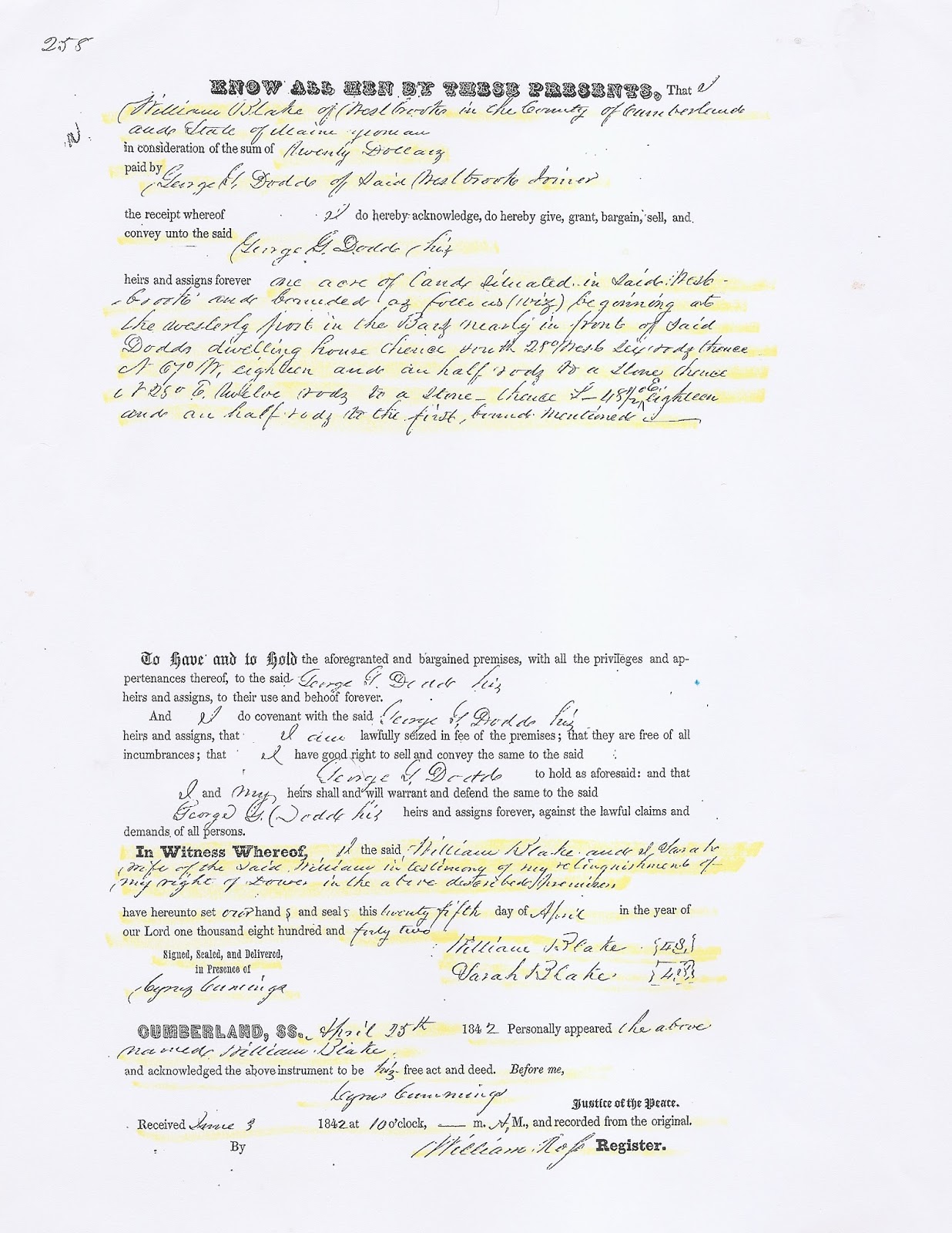
I've outlined the names of others who were living at the same time in the area now referred to as Westbrook.  In 1842, William and Sarah sold a piece of land to a Mr. Dodd which looks like an easement for his property.  I was amazed to find the names of other relatives in this deed and those that I will share,
 In less than a year's time, Sarah Blake died on June 18, 1843 and William Blake's life changed forever.  In 1844, by order of the Courts, Cyrus Cummings, an official of the town and Justice of the Peace was assigned as the guardian of William Blake who was declared non com pos mentis.  His property was sold or mortgaged and he was committed to the Portland Almshouse and hospital.
This photo was taken about 1880.


The census of 1850, shows his age as about 70, actually he would have been 76.  The final disposition of his property filed with the Court was in May 1853.  I presume he had died.


I intend to continue this piece later because I have more to share including deeds and the record of William Blake's service in the militia during the War of 1812.  The declaration of insanity during this period of history was viewed very differently during the early 18th and 19th centuries and must have been very difficult for William Blake's family and neighbors. 

A final question for now:   Was the death of William Blake's wife Sarah simply to much grief for him to bear and it sent him over the edge?