Saturday, November 15, 2014

TIMOTHY GALVIN - PART II

     Timothy Galvin was born in County Clare, Ireland located in the Mid-West Region,  also part of the province of Munster, on February 2, 1776.  Unfortunately, no records exist regarding his parents or family.  According to our resident expert on all things regarding the Irish who emigrated to America in the 18th and 19th century, Matt Jude Barker, records were not kept until much later, making it nearly impossible to find much pertinent information.  

An Aside

     The Galvin name seems to be somewhat controversial as to its origin. According to Ancestry: the Irish (version)  is a reduced Anglicized version form of Gaelic O' Gealbhan'; a personal name for:  'geal' bright  and 'ban' white, French: nickname for a 'cheerful drunkard'.  The family crest is somewhat more revealing:
I added this for those of you who may be interested in pursuing more information regarding the Galvin clan.
     Shortly after arriving in America, and settling in the East Deering area, Timothy married Joanna Illsley, born on February 14, 1769,a member of the prominent Illsley family on March 12, 1795.   Timothy was nineteen and Joanna, seven years his senior.  Idle curiosity, perhaps, but I wondered if this might have been an arranged marriage.  Timothy was young and possessed education and skill and I'm sure, would have been well received by the Illsley family.  
     
     Joanna and Timothy would produce at least six children, although,  because there is such scant information listed in the census records of 1810 and 1820, little is known about the children;  who they were and what became of them.  My hope is that any living descendants may provide some insight.

     Harriot Galvin, born in 1800, died at the age of five years and is interred at the Grand Trunk Cemetery.  The Maine Historical and Genealogical Recorder, vol 4, lists the inscription on her memorial stone.  It reads: 


       The census record of 1810 indicates that there was one male child under the age of ten, another boy, between 10 years and 15 years of age, a female child under 10 and another girl between 10 and 15 years of age.  However, Timothy's age is recorded as over 45.  He would have been 34 years of age, and Joanna, age 41.  Harriot had died five years before.

     In 1820, the record indicates that there were two boys under 10, and one boy between the age of 10 and 15.  There were also two female children between 10 and 15 years of age.  Tim's age is recorded again as over 45 years of age.


     If you recall from Matt Jude Barker's talk, there is some information about one of the Galvin children, George Illsley Galvin whose estate received the proceeds from the sale of his father's home and property. George died in 1841.  Again, only bits of information about this George have surfaced.  Apparently he moved to Calais, Maine where he was involved in the building of a church.  His name appears on this  document,  and in one of a court proceeding.


     While attempting to find out more about Timothy Galvin, I wondered if he may have been Catholic since the Galvin surname is one associated with that faith.  I did however, come across other information in the Maine Historical and Genealogical Recorder, Vol. 3 which indicated that Tim Galvin was a subscriber, along with several of his neighbors,  to Rev. Caleb Bradley's church.  The document is dated Falmouth, June 24, 1799.


     I've highlighted several familiar names of citizens of East Deering Village that I've previously written about in this blog:  Crispus Graves and Joseph Merrill stand out,  as well as several members of the Sawyer family.  Clearly, Timothy Galvin was an involved member of the community in many aspects of his life as a teacher and a surveyor, 'lawyer', husband and father.

     Theodore Sawyer's Back Cove to Quaker Lane continues to be a wonderful source of information and insight into the East Deering community at this period of history.  I am including two pages from his manuscript because of the wealth of information it contains regarding Tim Galvin's skill as a surveyor, his transactions with other citizens and information regarding his home in relation to the layout of the village.  

     Today, if you drive up Washington Avenue,  over the bridge into East Deering, you'll cross over Veranda Street.  Apparently, before Veranda Street existed, Tim Galvin's home was at the corner of Meadow Lane (now Washington Ave,)  I've been told he also owned a small shop.  To the left of the avenue, just past Bates Street, is 'Galvin Street'.  I imagine the street is named for our Timothy Galvin.  A bit further down the road, off West Presumpscot Street is 'Illsley Street', named, I'm sure for Capt. Isaac Illsley and the Illsley family.


     Timothy Galvin died on January 21, 1838 at the age of 61, just prior to his 62nd birthday.  His wife, Joanna Illsley Galvin died just two years later,  on April 4, 1840.  To date, we have been unable to find out whether Joanna was buried beside her husband.  In all probability, she was.  

     I hope that readers of this post about Timothy Galvin and his family will find it interesting,  as we continue to uncover more about those early citizens of East Deering Village,  and the story of how they  contributed to the history of our city of Portland, Maine.  Hopefully, readers may have clues and facts that they can add to the story so that the Remnant, that is the Grand Trunk Cemetery, and its inhabitants,  can be preserved in memory for years to come.

     Thanksgiving and the holiday season is fast approaching.  I wish each of you the very best of celebrations with family and friends.  I plan to resume my research and 'story telling' after the holidays.  Peace to All!

Sunday, November 9, 2014

Timothy Galvin- A Most Fascinating Irish School Master Part I

     In 1795, a young man of  just 19 years, named Timothy Galvin emigrated from Ireland and settled in the East Deering Village.  Sometime after his arrival, on March 12th of the same year he took a bride, Joanna Illsley, one of the nine children of Jonathan and Dorcas (Ingersoll) Illsley, and granddaughter of Capt. Isaac Illsley, Jr.,a prominent land owner and distinguished military man. 

     In 1796, Timothy Galvin added his support, along with other notable citizens of East Deering Village,  to an historic action, the building of the first school house for the children of the settlement.  Only here in America for a very short time, Tim  wasted no time in impacting his newly adopted home and fellow citizens as a school master, mathematician and surveyor.
*******************************************************************************************************

     Although, what we know of Timothy Galvin and his family is limited, his story is important to the history of East Deering and the city of Portland.  At our recent Dedication, Matthew Jude Barker, noted genealogist and Irish historian was unable to be present, but he graciously allowed me to post his speech. I'm sure, all of you who follow this blog will appreciate reading it, as it gives us further insight into  the question: "Who was Timothy Galvin ?"

Matthew Jude Barker

     Is a resident  historian and genealogist at the Maine Irish Heritage Center in Portland.  Matt has authored many historical articles and been contributing writer to several books including:
     They Change Their Sky:  The Irish In Maine (2004) and John Ford In Focus (2008).
In 2014, Matt's book:  The Irish of Portland, Maine was published.

Matt has recently completed  a major history of Portland Irish during the Civil War, and on December 2nd, will deliver a presentation at noon at the Maine Historical Society.

  Here in whole, is Matthew Jude Barker's speech about Timothy Galvin.


    I will complete the story of Timothy Galvin at a later date, and include some of the documents we have been able to find so as  to continue to add a face to those early settlers interred at the Grand Trunk Cemetery. I am grateful to Matt for contributing his own research, and as he said: 'The Search Goes On!'

Sunday, October 12, 2014

Dedication Highlights


On A Personal Note

     When planning this event, I invited three, noted Portland Historians, William David Barry, Matt Jude Barker and Herb Adams,  to speak and to share their historical perspective pertaining to the East Deering Village and the 'residents' of the Grand Trunk Cemetery.  Fortunately, all three excepted.  Unfortunately, Matthew Jude Barker was unable to participate due to a physical ailment.   However, Matt has agreed to share his thoughts which I will publish at a later date. 

     The first of the series was given by William D. Barry and he has given permission to publish the talk which I enjoyed,  and I know that readers of this blog will appreciate.


William David Barry

Is an historian, writer, exhibition organizer, and journalist, a Mainer by choice since the early 1970's, William has been on the staff of the Portland Museum of Art, the Portland Public Library, and the Maine Historical Society.  Bill Barry has authored and co-authored seven books.  His latest books include:  Deering:  A Social and Architectural History with Patricia Anderson and Maine:  The Wilder Half of New England.

A Historical Perspective


Many thanks to Bill Barry.  I hope followers of this blog enjoy reading his words as much as those of us who participated in the Dedication did hearing his talk.  More to come!

Upcoming Event

     Our fourth annual Fall Planting party will take place at the Grand Trunk Cemetery on , October 19th.  We would love to see many of you who live in the area next Sunday.  Our work to continue to add beauty to this lovely historical cemetery is on-going.


Monday, October 6, 2014

Milestone Reached for the 'Remnant' that is The Grand Trunk Cemetery: Dedication of Settlers' Memorial


Five of Anthony Sawyer's Descendants Participate In the Dedication.
Robert Sawyer, Jane Jordan, Susan Szewczyk, Theresa Sawyer Cobb, Benjamin Sawyer.

 Honoring the Memory of the Early Settlers of East Deering Village

     The day was made to order; crisp and comfortable.  Some sixty or so people from Portland, Falmouth, South Portland, Lisbon, Florida and New York attended the ceremony greeted by two young ladies, Miss Emma Brackett, dressed in Colonial garb, and Miss Megan Cunningham, in a Victorian style dress.  The two Girl Scouts chose to carry on the legacy of their now, adult Girl Scout sisters, Samantha Allshouse and Kayla Theriault by continuing to bring honor and beauty to the ancient cemetery with their own Bronze Award project of planting gardens and spear-heading two service projects with Portland Girl Scouts during the fall and spring each year.

     The City of Portland's Cemeteries Division spent several days preparing the grounds, installing the new stone, touching up the rail fence and the enclosures, painting the kiosk, clearing out brush behind the wire fence which will eventually be replaced.  The finishing touch was the addition of lovely fall mums.

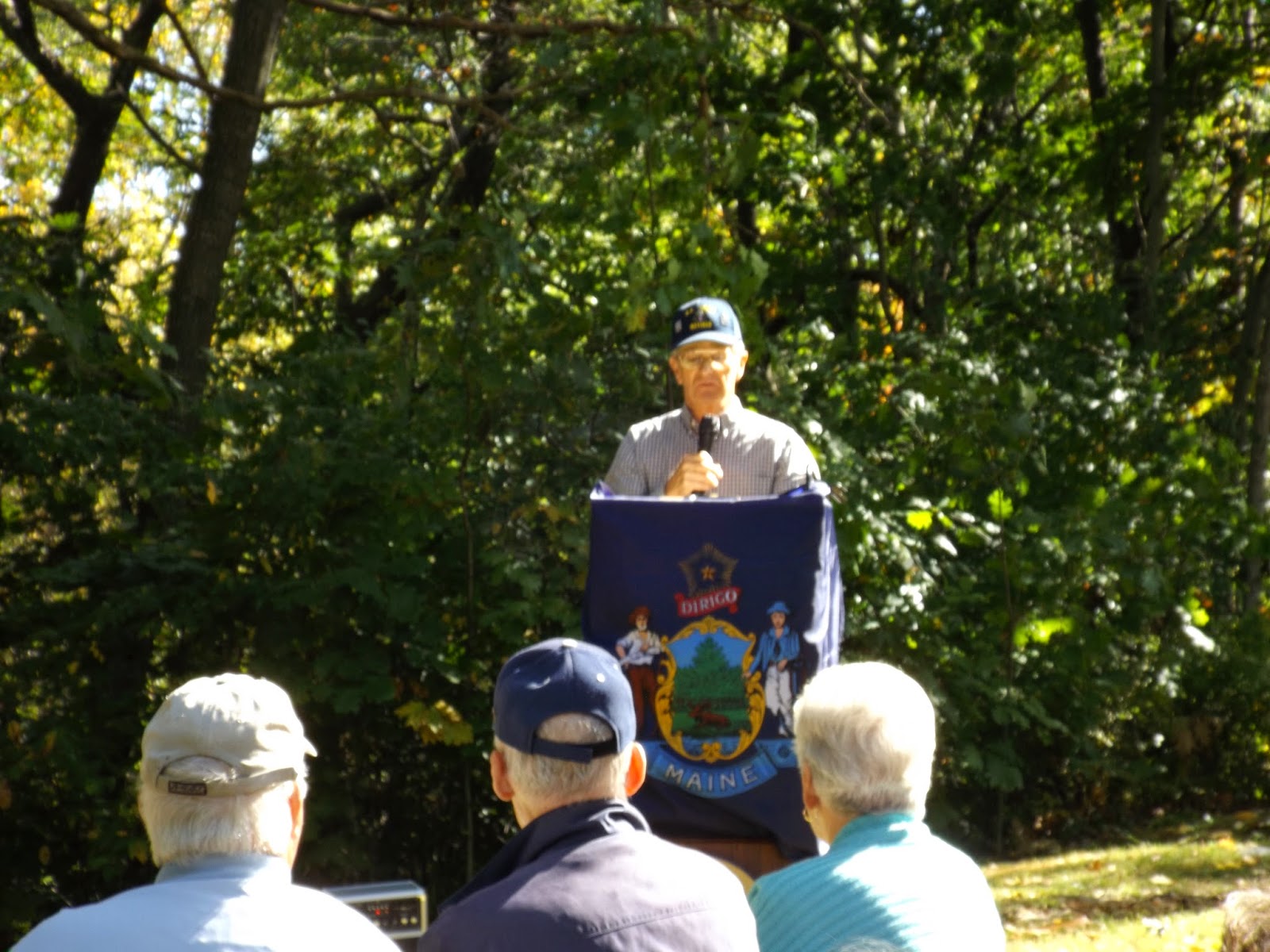
     The VFW Deering Memorial Post 6859 provided the Honor Guard, Rev. Carolyn Lambert, Pastor of Woodfords Congregational Church gave the Invocation and Benediction, 'Greetings from The City of Portland was delivered by Michael Bobinsky, Director of Public Services, and the speeches were inspiring delivered by two noted Maine historians:  William David Barry and Herb Adams.

     There were several touching moments for me, and I'm sure for those in attendance at the ceremony.  Brownie and Junior Girl Scouts, carrying baskets of flower petals,  sprinkled petals over the graves in a symbolic gesture of honor where once there was debris and disregard, while the surviving forty-seven names of settlers were recited.

     The plaque for Zoe's bench which had been keyed by mischief-makers was replaced with a brass, far nicer plaque, donated by Benjamin Sawyer and will be embedded in a granite marker to place beside the bench.  Zoe Sarnacki was a student at Presumpscot School in David Millard's class engaged in an earlier service learning grant project to recover the cemetery.  David, now retired, became Samantha Allshouse's mentor, and provided valuable historic material and direction.  David always hoped to place something in Zoe's memory at the cemetery since she had died a tragic death. When she was a student, Zoe  had been so interested and involved in the cemetery, along with her Dad.  It seemed appropriate that the final gesture for Sam and Kayla's Girl Scout Troop before graduation was to honor David's wish by purchasing and installing Zoe's bench.

  Finally, one of the most amazing outcomes of this reclamation project has been connecting with living relatives and in some cases, introducing them to one another for the first time.  This was certainly true at the ceremony when Jane A, Jordan revealed she was also a descendant of Anthony Sawyer and met the other Sawyers, two of whom traveled from Florida and New York to be present.

     I'm sure I could go on, but I'll save more of my comments for later.  In today's Portland Press Herald,  there is a great article by staff writer, Beth Quimby with wonderful photographs by Carl D. Walsh that I'm sure you will enjoy.  http://www.pressherald.com/2014/10/06/one-of-portlands-historic-cemeteries-brought-back-from-ruin/.

I hope you enjoy the Dedication photographs taken by LingLing Oum.


Wednesday, October 1, 2014

1796 Joseph Lunt and Village Leaders Form Committee to Build Schoolhouse!

INTRODUCTION

     It has been thirteen years since the war for independence ended.  Life in East Deering Village and the region is more stable.  Although Maine is still bound to Massachusetts, community leaders begin to take action to build for their future and that of their children.

     While completing  final preparations for our Dedication of the memorial for the Early Settlers of East Deering Village this Sunday, October 5th, I thought it timely and appropriate to share this wonderful  find from Joseph Lunt's personal papers.  The document is hand-written and too fragile to copy; none-the-less, it is very revealing since it contains the signatures of the 'subscribers', leaders in the village:

Joseph Lunt     George Illsley     Peter Noyes     Hutchinson Noyes     Ephraim Sawyer

Thomas Blake      Benjamin Sawyer     William Sawyer     Timothy Galvin John Sawyer

Anthony Sawyer     John Barber, Jr.     Zebulon Knight     Zebulon Sawyer     James Barber

Nathan sawyer     Benjamin Sawyer     Thomas Sawyer     John Barber     Josiah Barber

Asa Morrell     Asa Sawyer.


The Development of Education in Maine

    The Information included here is taken from "Maine Education -150 Years of Education in Maine -Part I."  http://www.maine.gov/education/150yrs/150part1.htm.

'The Massachusetts Bay Colony in 1652, claimed the Province of Maine under its charter...The purchase of the Province of Maine by Massachusetts removed all doubts to its claim and brought it under the Massachusetts Bay Colony Laws of 1642 and 1647 which contained the first legal requirements  regarding schools.  In 1642, the General Court of the Colony and Province of Massachusetts Bay had ordered
     "that the selectmen in every town, shall have a vigilant eye over their bretheren and          neighbors, to see first, that none of them shall suffer so much barbarism in any of their families, as not to endeavor to teach, by themselves or others, their children and apprentices, so much learning as may enable them, perfectly, to read the English tongue and knowledge of the capital laws, upon penalty of twenty shillings for neglect therein."

  This ancient law was the first step toward compulsory school attendance  and carried with it a punishable offence for neglecting this duty to educate children.  However, the earliest inhabitants of Maine, had more pressing matters to contend with like survival and subsistence.   During the early days, children did not venture far from home for safety, consequently, formal education was slow to develop, and it was around 1700 before schools were built and maintained.  In the 18th and 19th centuries, the roots of the educational system were slowly developed.

     One provision in the laws regarding education, stipulated that when there were at least 50 households, a committee should establish a schoolhouse, a reputable school master hired, and his salary be paid by 'the parents or the masters of the children, or by the inhabitants in general..."  When a town increased to one hundred families, the selectmen were to establish a 'grammar school to instruct youth for the university.'  A grammar school was considered more like our present day high schools or academies.


The East Deering Village Schoolhouse

     When Joseph Lunt and his fellow subscribers came together to formulate their plan for building a village school house, they each made a monetary commitment according to their
means.  The amounts were a great deal for this time: $35.00 to $5.00 in colonial currency.
     The document reads in part:  the Committee will build a school house "in a spot appointed by us adjoining the road below Benjamin Sawyer's house and the Back Cove Bridge, 20 feet long and 20 feet wide."

     I have tried to piece together some hints about the proposed location from information contained in Theodore Sawyer's  From Back Cove to Quaker Lane, where Ted speaks about the completion of the Back Cove Bridge (Tukey's Bridge) when people who lived near the Presumpscot River petitioned for a road.  

    "Following the same course as the bridge, a road was laid out for 28 rods until it encountered the Illsley-Noyes lot line: northwest by this line one hundred and eighty rods, then north 52 rods to the road leading to the lower bridge on the Presumpscot River, this last course (our Morse Street) passing between Col. Noyes' house and barn.  The second course lay all on the west on Major Illsley's land."

Could this be the school house from the photograph taken by LB Chapman in the late 1800's?  


     Exactly where was Benjamin Sawyer's house and which Benjamin Sawyer is referred to in the proposal?  You'll note their are two subscribers by the same name.  I 'll have to continue to research to see if there are more clues.  I'm excited to find this valuable piece of history because it's the first time so many of the early inhabitants of the East Deering Village are named together in one single action taken for the benefit of their community and for future generations.  More about this at a later date.

I hope to meet those of you who live in the Portland area at the Dedication Ceremony,this Sunday afternoon, at 1:30 PM at the East Deering/Grand Trunk Cemetery.  You will honor the memory of these early settlers by your presence and continue your interest and support for this reclamation project.